One of the most fundamental challenges in international development is context adaptation. To deliver long-lasting solutions, development organizations must first understand local constraints and tangible uniqueness in culture, economy, politics, history, and language.
However, in reality, I've seen several development projects still following the oversimplified logic of: "wealthy nations already have this, so let's give the same to the poor." In particular, with the rapid penetration of digital technologies, data-driven operations, and AI-assisted workflows in rich countries, international organizations and NGOs are eager to mimic the activities by investing in digital skills training programs and nation-wide digital transformation initiatives in the Global South — even though there is a great majority of disconnected populations who don't have stable internet or reliable computer devices at home.
This is what I call copy-and-paste development, surfacing the practical gaps overlooked by one-size-fits-all approaches. These projects can make people feel good in the short term, but their long-term sustainability is always questionable.
On a hot summer day in Malawi, I met a graduate of a computer education program I facilitated a year ago. In the classroom, he was one of many successful learners who were self-motivated and performed well during the exercises; organizations love to highlight them in "success stories." But now, without a computer, internet, money, or job opportunities, he reluctantly helps a friend's small shop in a local market to earn money to survive for a day or two.
The digital divide is partly caused by the lack of critical-thinking and problem-solving skills under uncertainties, and material provisions, such as sending computers, teaching how to use them, and building AI applications, are important yet insufficient. In fact, thriving skills can be learned even in an offline setup, but many naively treat computers and software tools as silver bullets.
An underlying problem, in my opinion, is goal setting. Now, the world seems to be in consensus that poor countries should "catch up" with what rich countries enjoy:
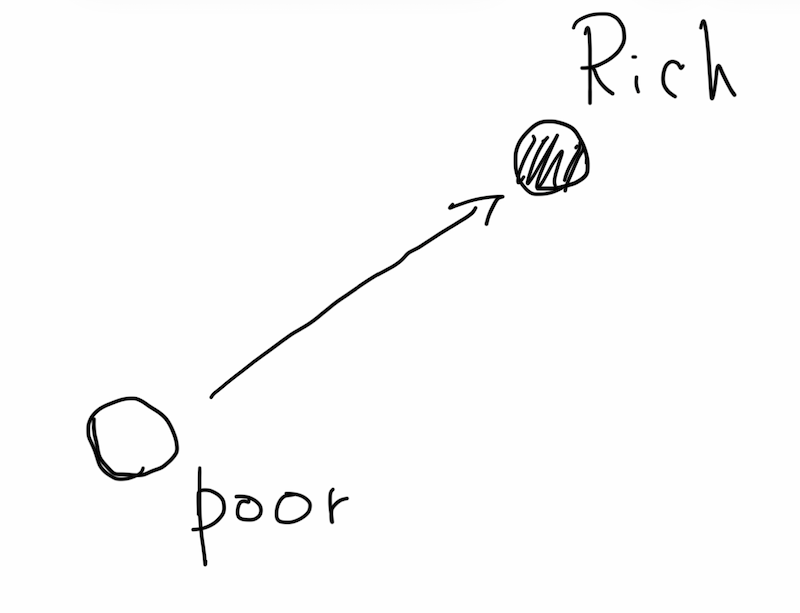
This linear path probably works best for essential matters such as WASH (water, sanitation, and hygiene) and peace. But keep in mind that this assumes the rich nations are "right" and assimilates the rest into the power of global politics and economy.
On the other hand, in technology, more is not always better. Digital applications introduce new problems such as fraud risks and misinformation and disinformation. With social media, mental health issues among young people are on the rise. AI helps people end their lives. Even among highly educated individuals in the Global North, technology often makes the world more complicated (not complex), polarized, and unhappy. That is, the rich are not necessarily "right" for humanity.
Therefore, we must consider technology as an auxiliary, not a destination. And it is essential for every context to define its own goal rather than imitating whatever others are doing:
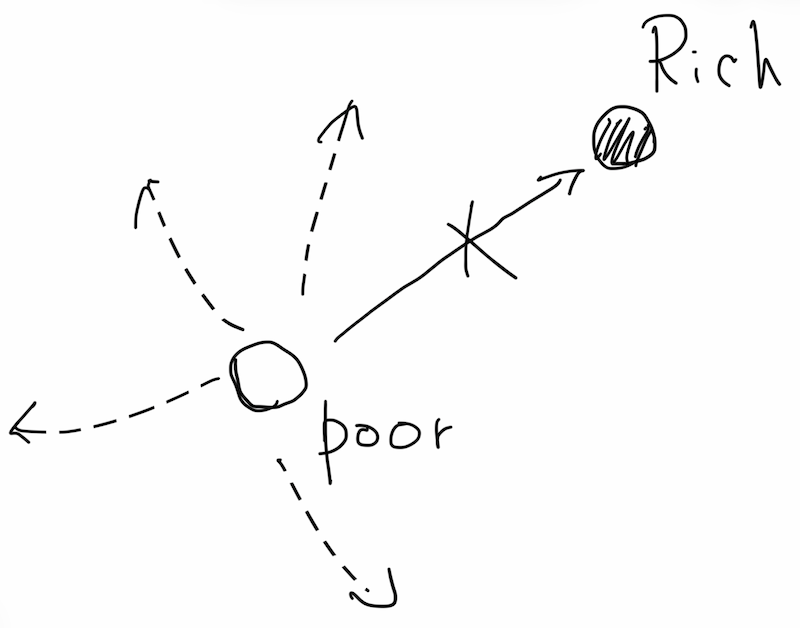
Enhanced productivity may be the universal goal in today's capitalist world. Even so, you can (should) still make your own definition of being productive that works in your context: Where are you now? How do you want to be? And how do we measure it?
Otherwise, development work lacks humanity as long as you blindly believe in the positive impact of AI and digital transformation. I'm sure you are smart enough to execute these initiatives. Yet, please pause for a moment and question the fundamental assumptions before proceeding.
This article is part of the series: Altruistic Byte: Real-World Insights for Tech-Driven ChangeSupport
Support my work with a coffeeCategories
See also
- January 1, 2026
- Why Offline Learning Still Matters in 2026
- December 5, 2025
- Missing Link to Bridge the Digital Divide
- November 30, 2023
- Is Computer Education Always Good?
Author: Takuya Kitazawa
I am a product builder, mentor, and advocate for sustainable technology development with a decade of experience in AI/ML products, data systems, and digital transformation. Based in Canada and originally from Japan, I have lived and worked globally, including part-time residence in Malawi, Africa. Visit my portfolio to learn more about my work, or reach out to me at [email protected].
NowDisclaimer
- Opinions are my own and do not represent the views of organizations I am/was belonging to.
- I use Grammarly for correcting grammatical errors, but I do not rely on any other generative AI tools to create my blog content.
- I am doing my best to ensure the accuracy and fair use of the information. However, there might be some errors, outdated information, or biased subjective statements due to the nature of a personal website. Visitors understand the limitations and rely on any information at their own risk.
- If there are any issues with the content, please contact me so I can take the necessary action.