Digital literacy and skills are essential anywhere across the globe, but especially in developing countries where socioeconomic opportunities are limited. In the constrained environment, ICT can be a game-changing tool that eliminates physical boundaries and unlocks numerous possibilities in and beyond communities of the oppressed.
Thus, governments and organizations actively invest in technology development in the following forms.
- Infrastructure: Internet penetration remains a key issue among us. We have policies and strategies, and continue to invest in the basic needs in collaboration with the private sector, like telecom companies.
- Funding: Don't have money and equipment in the households and communities? No worries, we support the financing and procurement of phones and computers. We have funds available.
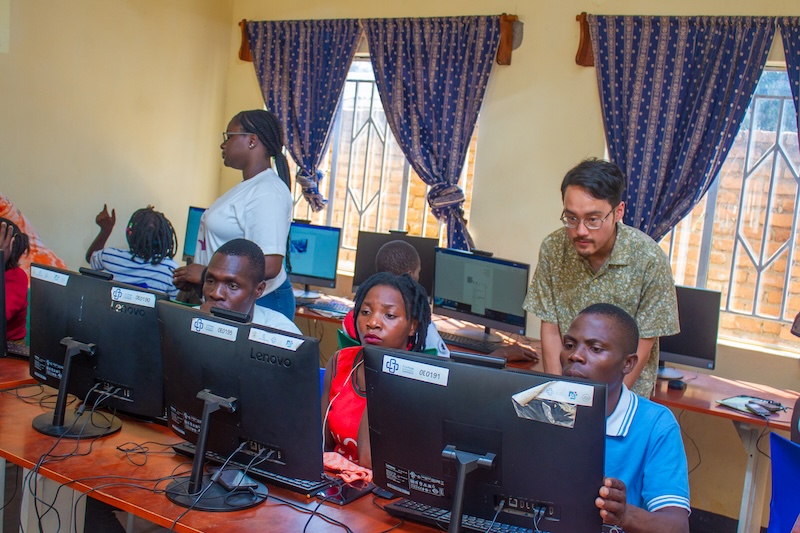
- Training: Let's teach digital skills, such as typing, coding, and using AIs, to marginalized people. We run many programs across the countries.
- The Impact: Employability of the target population increases, and they will eventually land jobs and become self-resilient. That's the way to an equitable society and poverty eradication!
This is, in fact, the narrative behind a lot of development initiatives and success stories focusing on digital skills. For example, the World Bank reported the positive impact of "digital skills for jobs" projects in the Middle East and North Africa context. The initiative doesn't seem different from the problematic approach I witnessed in southern Africa, though.
Unfortunately, such changemakers' logic is often a bit too simplistic and addresses a fraction of the big issue.
Unpacking the Big Issue
Well, what is the "issue" we are dealing with? That's digital divide. And scholars suggest that there are three levels of literacy gap: (1) access, (2) digital skills and usage, and (3) outcomes.1 We'd need to address all of them, holistically.
The fundamental accessibility gap commonly means the lack of devices, poor internet connectivity, and limited opportunity and/or motivation to use digital technology itself. This is the area that infrastructure development projects tackle with the help of funding.
Meanwhile, the second level of divide concerns HOW-TOs, such as usage of devices, navigating websites, email and social media communication, and content creation. Funds (often grant-based) also help individuals and organizations implement training programs to bridge the gap.
Up until this phase, activities are, in my experience, more of a number (and political) game. Quantity over quality, that is. Thanks to growing interests both from public and private players, it is relatively straightforward to implement digital infrastructure and education programs, and the results are strongly driven by pushes from those who hold the power, i.e., top-down development. Hence, the penetration would be a matter of time, as the other parts of the world have already experienced.
On the other hand, going beyond necessities and transforming the tools into tangible outcomes requires bottom-up efforts. Such a barrier is the third level of digital divide and an ultimate factor of the Impact; otherwise, it's pointless if trained people, with smartphones, 5G internet, and AI applications, cannot decide what to do next without external intervention. This part is critically missing in the development sector, even in a narrative that claims to bridge the digital divide.
Pushy Intervention, Manipulated People
Let's be honest. In reality, numerous digitally skilled/literate people cannot seize meaningful outcomes due to the missing link.
- Watching fitness-related YouTube videos for countless hours without actually improving your own health.
- Aimlessly scrolling social media feeds and gaining nothing from the network other than posting own photos and commenting on gossip.
- Capable of creating digital content, but doesn't know how to turn the skill into a viable business.
- Asking AI how to achieve financial freedom, but cannot examine whether the information is trustworthy or not.
They have access, knowledge, and skills. But most people I met in the field still struggle with applying what they passively learned to real-life problems. Without bridging the gap, all interventions simply contribute to creating zombies, i.e., passive consumers of digital information. Subsequently, the development efforts only amplify the inequality between the privileged and the rest, and introduce power dynamics and exploitation opportunities in and beyond the communities.
Ultimately, if we passively learn a new skill, e.g., because it's trending in the market, how can such reactive people survive in the next wave? Technological trends and business landscape change day by day, so the Impact depends on how adaptive he or she is under uncertainties.
Redefining "Digital Skills"
Therefore, nurturing active participants in the digital economy who have problem-solving and critical thinking skills is essential.
In practice, it implies investing more in scalable personal traits. A large-scale study conducted in Togo in Western Africa revealed that educating "a mindset of self-starting behavior, innovation, identifying and exploiting new opportunities, goal-setting, planning and feedback cycles, and overcoming obstacles" led a lasting, greater profit increase among small businesses, rather than teaching traditional business practices such as business modeling, bookkeeping, and marketing.
Why don't we apply the insight to our field activities in tech? When people holding the power speak about digital skills today, it primarily focuses on traditional practices. What if learners, or beneficiaries at large, receive more opportunities to think and discover by themselves?
That is, the field probably needs more problem-posing education.
1. Ireland, J., & Lestari, S. (2025) Digital divide: A literature review. A Cambridge University Press & Assessment publication. ↩This article is part of the series: Altruistic Byte: Real-World Insights for Tech-Driven Change Digital Malawi: Developing Hope in the Information Age
Support
Support my work with a coffeeCategories
See also
- June 24, 2024
- The End of the Beginning—What I Talk About When I Talk About Malawi
- November 30, 2023
- Is Computer Education Always Good?
- September 8, 2023
- Definition, Role, and Current Status of Digital Literacy in Malawi #LiteracyDay
Author: Takuya Kitazawa
I am a product builder, mentor, and advocate for sustainable technology development with a decade of experience in AI/ML products, data systems, and digital transformation. Based in Canada and originally from Japan, I have lived and worked globally, including part-time residence in Malawi, Africa. Visit my portfolio to learn more about my work, or reach out to me at [email protected].
NowDisclaimer
- Opinions are my own and do not represent the views of organizations I am/was belonging to.
- I use Grammarly for correcting grammatical errors, but I do not rely on any other generative AI tools to create my blog content.
- I am doing my best to ensure the accuracy and fair use of the information. However, there might be some errors, outdated information, or biased subjective statements due to the nature of a personal website. Visitors understand the limitations and rely on any information at their own risk.
- If there are any issues with the content, please contact me so I can take the necessary action.